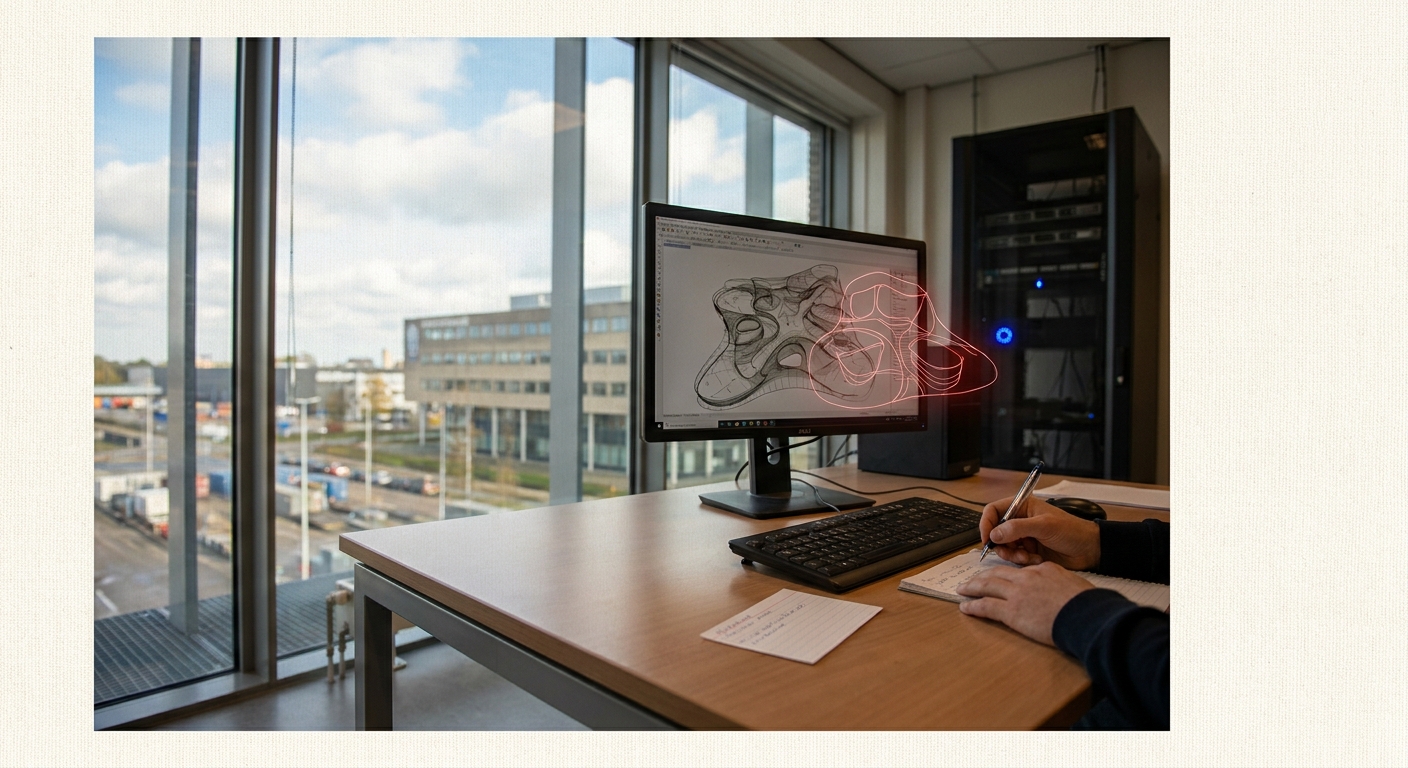
Researchers found that adding a single sentence to AI prompts significantly increases model creativity. The finding, reported by VentureBeat, requires no model retraining or extra compute.
Capability without cost is the story. The buyer who masters prompt craft beats the lab that sells fine-tuning. Netherlands operators should test this before paying for the upgrade.
Over half (51 percent) of young Dutch people who use AI discuss personal matters like dating, social situations, and mental health with the chatbot, an EenVandaag survey of roughly 1,100 panel members aged 16 to 34 found. A quarter (23 percent) say they share more with the chatbot than with friends and family.
The scarce commodity was never information, it was a nonjudgmental listener at 2 AM. A quarter of young users routing intimacy through foreign-run models is an infrastructure dependency no sovereignty strategy currently covers.
The Amsterdam AI Coalition, a partnership between the city government, University of Amsterdam, and local AI companies, has released an open-source toolkit for detecting and mitigating bias in AI systems. The toolkit includes testing frameworks for gender, ethnic, and socioeconomic bias across text generation, classification, and recommendation systems. It is designed to help organizations meet EU AI Act fairness requirements and has been adopted by several Dutch government agencies for internal AI audits.
Open-source bias detection tooling tied to EU AI Act requirements has genuine adoption potential — it solves a problem every European AI deployer now faces. Watch for this becoming a de facto standard if other EU cities adopt it.
TU Delft and Leiden University have launched a joint research program on AI safety and alignment, funded with €15 million from the Dutch Research Council. The program will investigate value alignment in language models, safe deployment of autonomous systems, and human-AI collaboration frameworks. Ten new faculty positions and 25 PhD candidates will be recruited, making it the largest AI safety research initiative in the Benelux region.
AI safety research in Europe has been underfunded relative to the UK's focus at Oxford and Cambridge. This program could establish the Netherlands as a continental hub for alignment research — the 25 PhD positions will build a pipeline.